Best CRM for Small Agencies

If you run a small recruitment agency, choosing a CRM is harder than it should be.

You’ll find platforms built for global recruitment businesses with huge teams, complicated processes, and even bigger budgets.

But if there are 1, 5 or 10 of you in the agency, do you really need hundreds of features, months of implementation, and a system that requires endless training?

Probably not.

You need something that helps you make placements.

Whether that’s managing candidates, tracking clients, or using a dedicated recruitment CRM and ATS, having the right technology stack makes a huge difference.

Something that keeps your candidates, clients, jobs and communication organised.

Something that saves you time instead of creating more admin.

So, let’s look at what small recruitment agencies actually need from a CRM, where many systems go wrong, and the best recruitment CRMs worth considering.

What Small Agencies Actually Need from a CRM

Before comparing platforms, it’s worth asking a simple question:

What does a small recruitment agency actually need?

Most small teams need a recruitment CRM that:

  • Saves time rather than creating extra admin
  • Keeps candidates, clients and jobs in one place
  • Helps automate repetitive tasks
  • Makes communication easier
  • Integrates with the tools recruiters already use
  • Is simple enough that the whole team actually uses it
  • Doesn’t cost the same as hiring another employee

Big agencies often have operations teams to manage complicated systems.

Small agencies need software that just works.

Where Most Recruitment CRMs Go Wrong

A lot of recruitment CRMs were originally designed for larger agencies.

And there is nothing wrong with that.

Large agencies need complex reporting, approval processes, multiple teams, and endless customisation.

But smaller recruitment businesses often need the opposite.

Common frustrations include:

  • Too many clicks to complete basic tasks
  • Complicated workflows
  • Long implementation times
  • Expensive contracts
  • Paying for features you never use
  • Add-ons increasing the real monthly cost

The best CRM for small agencies should make recruiters faster.

Not give them another system to manage.

Best CRM for Small Agencies: Top Options

Here are some of the leading recruitment CRMs small agencies should consider.

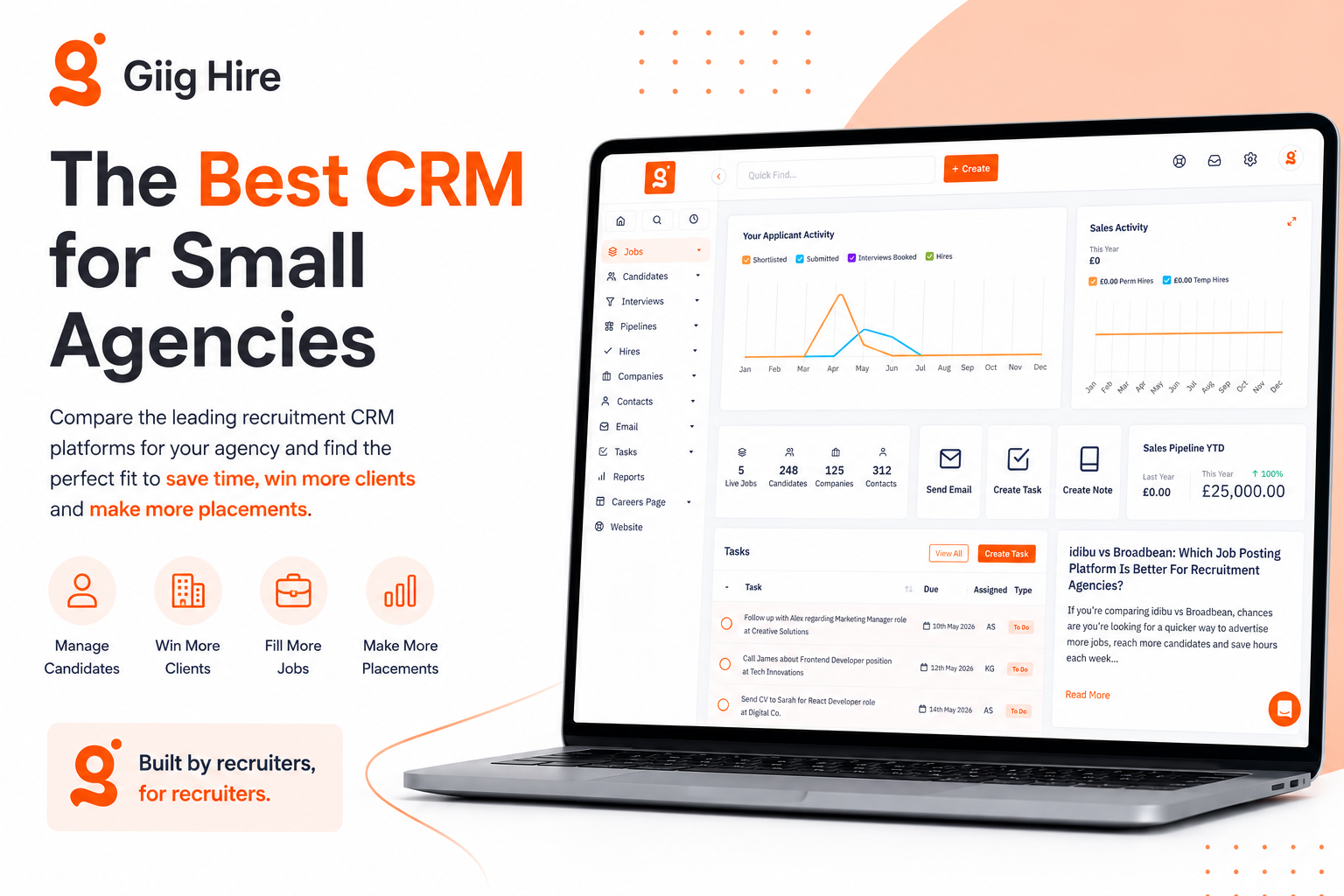
1. Giig Hire: Built by Recruiters for Small Recruitment Agencies

Giig Hire was created specifically for small and growing recruitment agencies looking for an affordable recruitment CRM.

We weren’t trying to build another enterprise recruitment system.

The goal was simple:

Build the CRM we wanted when running a recruitment agency.

Something powerful enough to help recruiters grow, but simple enough that you can start using it straight away.

Why small agencies choose Giig Hire:

  • Recruitment CRM + ATS in one platform
  • Free forever plan available
  • Affordable monthly pricing
  • No long-term contracts
  • Candidate and client management
  • Drag-and-drop recruitment pipelines
  • CV parsing
  • Automated CV formatting
  • Email integration
  • LinkedIn Chrome Extension
  • Careers page included
  • Multi-job board posting through our Idibu job posting integration
  • Ringover phone integration
  • Claude AI integration (MCP)

Bringing AI into recruitment CRM

AI is changing how recruiters work.

But historically, the best technology has always been reserved for the biggest companies with the biggest budgets.

That shouldn’t be the case.

With Giig Hire’s Claude integration, small agencies can start connecting AI directly with their recruitment CRM.

Imagine asking your CRM:

“Find me every Java Developer based in London with fintech experience who I spoke with in the last 2 years.”

Or:

“Review this job description and find candidates already in my database who could be suitable.”

Or:

“Research this market and help me identify companies that might be hiring.”

That is where recruitment technology is heading.

AI won’t replace great recruiters.

But recruiters using AI will have a huge advantage.

Things to consider:

Giig is focused on small and growing recruitment agencies.

Larger enterprise businesses with highly complex global workflows may prefer enterprise platforms.

But for agencies wanting a simple, affordable and modern recruitment CRM, Giig Hire is designed exactly for that.

2. Bullhorn ATS & CRM

Why consider Bullhorn:

Bullhorn is one of the biggest and most recognised names in recruitment technology.

It offers:

  • Advanced CRM and ATS functionality
  • Reporting tools
  • Large integration marketplace
  • Custom workflows
  • Enterprise-level functionality

For larger recruitment agencies with complex requirements, Bullhorn can be a great option.

Things to consider:

For smaller agencies, it can sometimes be more than you need.

Consider:

  • Implementation time
  • Training requirements
  • Cost
  • Complexity

If you are a small agency, ask yourself:

Do you need every feature?

Or do you need something your team can start using immediately?

If you’re comparing the two platforms, we’ve written a full breakdown here: Giig Hire vs Bullhorn

3. Zoho Recruit

Why consider Zoho Recruit:

Zoho Recruit offers a broad recruitment CRM and ATS solution.

Features include:

  • Candidate management
  • Job posting
  • CV parsing
  • Reporting
  • Integrations

It can be a good option for businesses already using other Zoho products.

Things to consider:

Zoho is not purely recruitment-focused.

Because it offers a wide range of business tools, some agencies may need additional setup and configuration to make it work exactly how they recruit.

4. Loxo

Why consider Loxo:

Loxo positions itself as a Talent Intelligence Platform.

It combines:

  • CRM
  • ATS
  • Candidate sourcing
  • Outreach
  • Automation tools

It is particularly popular with agencies focused heavily on sourcing and executive search.

Things to consider:

Advanced functionality is great if you use it.

But smaller agencies should consider whether they need every feature from day one.

Sometimes starting simple and scaling is the better approach.

For a deeper comparison, read our guide: Giig Hire vs Loxo

5. Recruit CRM

Why consider Recruit CRM:

Recruit CRM provides recruitment-specific software including:

  • ATS functionality
  • CRM tools
  • Automation
  • LinkedIn integration
  • Workflow management

It is a strong option for agencies wanting lots of features and configuration.

Things to consider:

More functionality usually means more setup.

For smaller teams, make sure the additional features are things you genuinely need and will use.

6. Manatal

Why consider Manatal:

Manatal offers a modern recruitment platform with:

  • ATS
  • CRM
  • AI recommendations
  • Candidate management

It provides a good balance between features and affordability.

Things to consider:

As with any system, make sure the workflows match the way your agency operates.

The best CRM is the one your recruiters actually use.

Which Recruitment CRM Is Right For Your Agency?

Agency TypeCRM To Consider
Solo recruiter starting outGiig Hire / Manatal
Small recruitment agency (1-10 users)Giig Hire
Enterprise recruitment agencyBullhorn
Executive search agencyLoxo
Agencies wanting lots of configurationRecruit CRM / Zoho Recruit

Best CRM for Small Agencies Comparison

CRMBest ForKey Features
Giig HireSmall recruitment agenciesCRM, ATS, Careers Page, AI, Idibu, Ringover, Chrome Extension
BullhornLarger agenciesEnterprise workflows, reporting, integrations
Zoho RecruitGeneral business usersATS, CRM, Zoho ecosystem
LoxoSearch-focused recruitersSourcing, outreach, talent intelligence
Recruit CRMGrowing agencies wanting customisationAutomation, workflows, recruitment tools
ManatalAgencies wanting an affordable ATSAI features, CRM, candidate management

How To Choose The Best CRM For Your Recruitment Agency

Before choosing software, ask yourself:

1. What problem are you solving?

Are you losing candidate information?

Struggling with admin?

Spending too much time formatting CVs?

Your CRM should solve your biggest problems first.

2. How quickly can you start?

A CRM is only valuable if people use it.

Look for:

  • Easy setup
  • Simple workflows
  • Minimal training
  • Good support

3. Does it grow with you?

Your first CRM should support you now and as your agency grows.

Look at:

  • Pricing flexibility
  • Integrations
  • Automation
  • Data ownership

4. Does it work how recruiters actually work?

Recruitment is unique.

A good recruitment CRM should understand:

  • Candidates
  • Clients
  • Jobs
  • Shortlists
  • Interviews
  • Placements

Not just generic sales pipelines.

Frequently Asked Questions

What is the best CRM for a small recruitment agency?

The best CRM depends on your agency size, budget and requirements.

Small recruitment agencies usually benefit from CRMs that are simple, affordable and quick to implement.

Do recruitment agencies need both an ATS and CRM?

Yes.

A CRM helps manage clients, companies and relationships.

An ATS helps manage candidates, jobs and recruitment processes.

Most recruitment agencies need both.

Is there a free CRM for recruitment agencies?

Yes.

Some recruitment platforms, including Giig Hire, offer free CRM options for recruiters starting out.

Should small agencies use AI recruitment software?

AI is becoming increasingly valuable in recruitment.

It can help recruiters search data, write content, analyse information and reduce repetitive admin.

The key is combining AI with recruiter knowledge rather than replacing human relationships.

Final Thoughts

Choosing the best CRM for your small recruitment agency isn’t about finding the system with the longest feature list.

It’s about finding the system that helps you make more placements.

The CRM you actually use will always beat the CRM with hundreds of features you never touch.

For small agencies, the future is simple:

Better systems.

Better integrations.

Smarter AI.

If you’re a small recruitment agency looking for a simple CRM built around the way recruiters actually work, you can try Giig Hire for free today.