If you have been following the latest developments in Artificial Intelligence, you may have seen three letters appearing more and more often: MCP.
But what is MCP, and why should a recruiter care about it?
MCP stands for Model Context Protocol. It gives AI applications a consistent way to communicate with other software and use the information or functions that software makes available.
That may still sound like something written for a room full of developers.
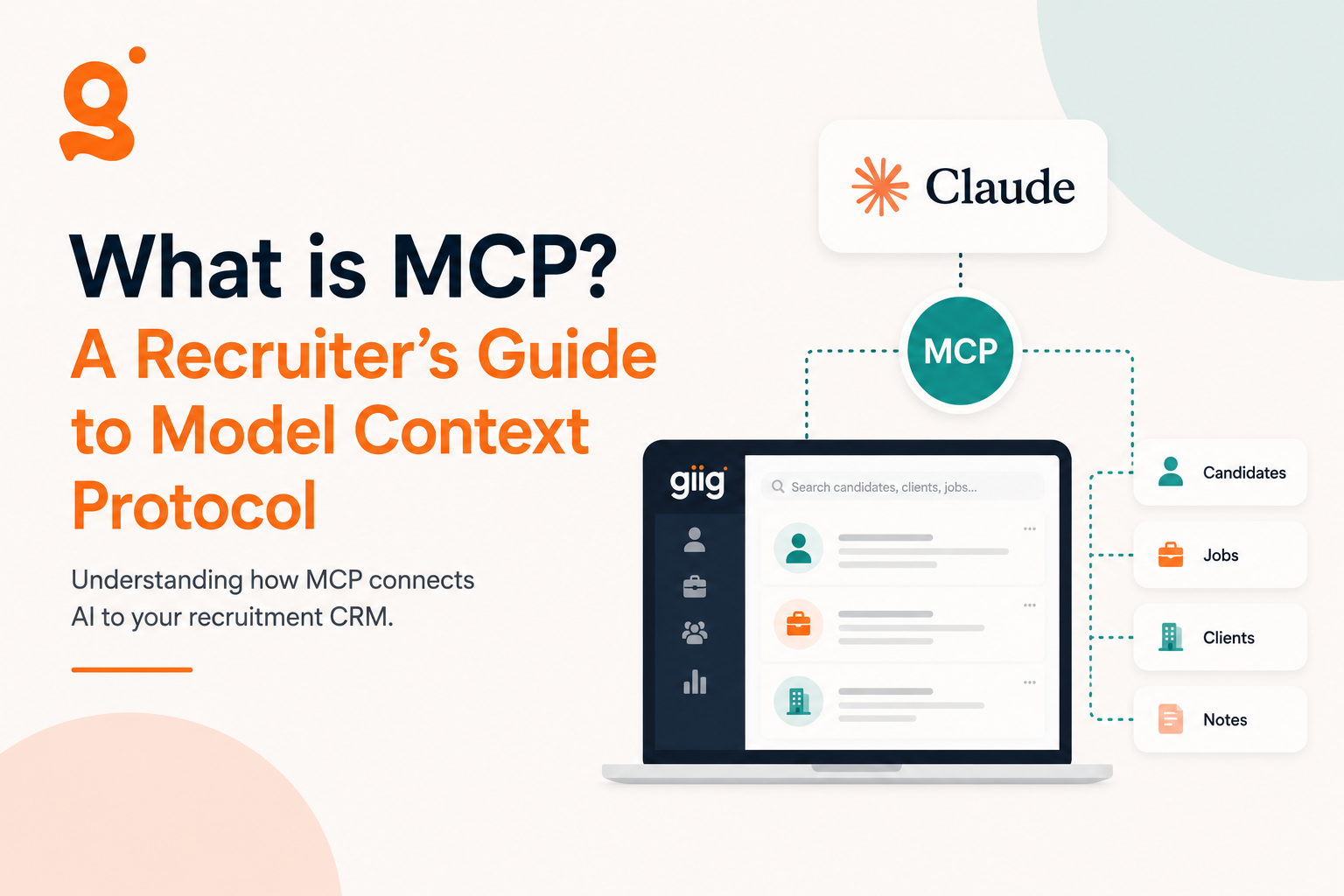
For recruiters, the simpler explanation is this: MCP can allow an AI assistant to work with your recruitment CRM rather than sitting in a separate window with no knowledge of your candidates, clients or jobs.
That difference is important.
AI has already become very good at helping with isolated tasks. Give it a job description and it can turn it into an advert. Paste in a CV and it can produce a summary. Explain the tone you want and it can draft an email.
The problem is everything you have to do before that prompt.
You find the record. Open the notes. Copy the vacancy. Paste the candidate details. Explain the client. Then you finally ask the AI to help.
MCP is part of the move away from that disconnected way of working.
What does MCP stand for?
MCP stands for Model Context Protocol.
It helps to look at the three words separately.
- Model means the AI model being used by an application such as Claude.
- Context means the information the AI needs to understand the request properly.
- Protocol means a shared set of rules that allows different systems to communicate.
Imagine hiring a brilliant researcher who knows nothing about your desk.
They may be capable, quick and good at following instructions, but they cannot do much useful work until they know where your information is kept and how they are allowed to access it.
MCP provides a structured way for an AI application to be shown the relevant doors, understand what is behind each one and use only the capabilities it has been given.
It is not the intelligence itself. It is the connection that helps the intelligence work with other systems.
Why has MCP become important?
The first wave of everyday AI use was mostly based on prompts.
You supplied some information, asked for an output and received an answer.
That works well for one-off tasks, but businesses do not run on isolated blocks of text. Their useful information is spread across CRMs, inboxes, calendars, documents, databases and specialist platforms.
Building a separate, custom AI integration for every combination of tools would be slow and expensive. Each AI provider and each software company could end up creating its own way of doing the same job.
MCP offers a common approach.
A software provider can make selected data and functions available through an MCP server. An AI application that supports MCP can then understand how to use them.
This is why MCP has attracted so much attention. It helps turn AI from something you talk to into something that can work with the tools around it.
How does MCP work?
There are a few technical parts behind an MCP connection, but recruiters do not need to become developers to understand the basic flow.
The AI application
This is the place where the user asks questions and receives answers. Claude is one example, although MCP is an open standard and is not limited to one AI provider.
The MCP client
The client sits within the AI application and manages its MCP connections. It helps the application understand what connected services are available.
The MCP server
The server represents the external platform. It describes the approved information and functions the AI application can use.
An MCP server for a recruitment CRM might allow an AI application to search candidates, retrieve a job record or review activity linked to a company.
When a recruiter asks a question, the AI can decide whether one of those available functions will help. The request is sent through the connection, the CRM returns the permitted information and the AI uses it to produce a response.
The exact capabilities depend on the integration. Connecting through MCP does not automatically mean an AI tool can see or change everything in a platform.
What can an MCP server provide?
You will often see MCP discussed in terms of resources, tools and prompts.
Resources
Resources are pieces of information made available as context. Depending on the system, that might include records, files or other stored information.
Tools
Tools are specific functions the AI application can request. Searching a database, retrieving a record and updating an item are examples of possible tools.
Prompts
Prompts are reusable instructions that can help guide a particular task or process.
What matters to the end user is not the terminology. It is that the AI application can understand what is available instead of relying on the user to transfer every piece of information manually.
What is MCP in recruitment?
A recruitment CRM is full of context.
It contains the people you know, the businesses you have spoken to, the vacancies you have worked, the conversations you have had and the outcomes you have recorded.
Recruiters are not normally short of information. They are short of time to find it, compare it and turn it into the next useful action.
MCP can give an AI application a controlled route into that working context.
Instead of starting with a blank conversation, the AI can use approved CRM functions to help answer questions about the recruitment desk.
The results will only ever be as useful as the information being recorded. This is one reason we recommend thinking carefully about the recruitment custom fields your agency tracks and when to use custom fields instead of custom tags.
Good AI does not make poor data disappear. It makes well-organised data easier to use.
How could recruiters use MCP?
The best way to understand MCP is to look at the work it could support.
Finding candidates without guessing the right filters
A recruiter could describe the person they need in ordinary language:
Find candidates near Bristol with B2B SaaS sales experience who have managed a team and have been contacted within the past year.
The AI application could use the CRM’s search capability, interpret the results and explain why particular candidates may be relevant.
Looking beyond the obvious shortlist
Most agencies have candidates in their CRM who were strong but not right for the vacancy available at the time.
An AI assistant connected through MCP could help revisit those records when a new role arrives. The value is not in producing another list from the open market. It is in making better use of the network the recruiter already owns.
Getting ready for a client conversation
Rather than opening several company, contact and job records before a call, a recruiter could request a briefing covering recent vacancies, previous introductions, key contacts and outstanding actions.
The recruiter still decides what matters and leads the conversation. The AI reduces the preparation time.
Identifying gaps in activity
A connected assistant could help find candidates who need a follow-up, clients with no recent contact or vacancies where activity has slowed.
This is where a clear process remains essential. Technology can highlight what has been recorded, but it cannot rescue a desk where important information never reaches the CRM. Our article on why recruitment process should come before technology explores that in more detail.
Turning CRM information into useful content
Once the right context is available, the AI can help prepare candidate summaries, outreach messages, job adverts or meeting notes without the recruiter rebuilding the background every time.
For more practical ideas, we have put together 50 Claude AI prompts for recruiters.
What is the difference between MCP and an API?
APIs have been connecting software for a long time, so it is reasonable to ask whether MCP is simply another name for the same thing.
It is not, although the two can work together.
An API defines how software can request data or trigger functions in another platform. A traditional integration is normally built for a particular purpose, with developers deciding in advance how the two systems will interact.
MCP is designed around AI applications. It gives them a standard way to discover the capabilities available from a connected server and use those capabilities when they are relevant to a user’s request.
An MCP server may rely on a platform’s API underneath. MCP provides the AI-facing layer that describes the available tools and context in a consistent format.
A useful distinction is:
- An API connects software to software.
- MCP helps an AI application understand how it can use a connected system.
MCP does not make APIs unnecessary. In many cases, they will be part of the same solution.
Is MCP secure?
MCP makes connections possible. It does not make every connection automatically safe.
Security depends on how the MCP server, AI application, authentication and permissions have been implemented.
This is especially important in recruitment because a CRM can contain personal data, confidential notes and commercially sensitive information.
Before using any MCP connection, an agency should know:
- Which records and functions are being made available
- How the user proves their identity
- Whether CRM permissions are respected
- Whether the connection is read-only or can make changes
- What information is sent to the AI provider
- How access can be withdrawn
- When the user must approve an action
The safest approach is not to give an AI tool every possible capability because it might be useful one day. Access should be appropriate to the task and the person using it.
MCP is the method of communication. The provider still has to build security and sensible controls around it.
Do recruiters need to understand the technology?
Recruiters do not need to know how to build an MCP server any more than they need to understand the code behind their email integration.
The setup and technical decisions belong to the software providers.
For the recruiter, the experience should be straightforward: connect an approved service, understand what access is being granted and start asking useful questions.
Knowing the basics is still valuable. It helps recruitment leaders judge which AI features are genuinely connected to their business and which are simply standalone writing tools with a new label.
How does MCP work with Giig Hire?
Giig Claude MCP allows Claude to work with the approved information and functions available from a Giig Hire account.
Without that connection, Claude only knows what the recruiter adds to the conversation. With Giig Claude MCP, the recruiter can ask Claude to help with work involving their CRM data.
This is not about asking AI to take over recruitment.
The most valuable parts of the job still depend on people. Understanding motivation, building trust, advising a client and knowing when somebody is genuinely right for an opportunity are human skills.
Our aim is to reduce the work that gets in the way of those skills.
We built Giig for small and growing recruitment agencies, where the same person may be sourcing candidates, speaking to clients, writing adverts and running the business. Connected AI can give that recruiter additional support without requiring an enterprise technology team.
You can read more about that thinking in AI for Recruitment Agencies: How Giig Hire Is Making AI Accessible.
Why will MCP matter to recruitment agencies?
The main benefit of MCP is not that it lets AI write more words.
Recruiters can already generate plenty of content.
The bigger opportunity is helping AI work with the information and systems behind the recruitment process.
That could make it easier to uncover overlooked candidates, prepare for conversations, understand what is happening across a desk and decide what deserves attention next.
For a small agency, those saved minutes add up. More importantly, fewer opportunities are left buried in the database because nobody had time to find them.
MCP is still developing, and the ways recruitment platforms use it will continue to evolve. However, the direction is already clear: AI is becoming more useful when it can operate with relevant business context rather than waiting for somebody to paste that context into every conversation.
Frequently asked questions about MCP
What is MCP in simple terms?
MCP is an open standard that allows an AI application to connect with external software and use the tools or information that software makes available.
Who created MCP?
Anthropic introduced Model Context Protocol as an open standard in November 2024. The project was later donated to the Linux Foundation’s Agentic AI Foundation.
Is MCP an AI model?
No. MCP is not a chatbot or an AI model. It is a standard used to connect AI applications with other systems.
What is an MCP server?
An MCP server makes selected capabilities from a platform available in a format that an MCP-compatible AI application can understand.
Is MCP only available in Claude?
No. Claude was an early adopter, but MCP is an open standard that can be supported by other AI applications and software providers.
Can MCP change information in a CRM?
It can support tools that take actions, but only when the MCP server provides those tools and the user has the necessary permission. Some connections may only allow information to be read.
Will MCP replace recruitment CRMs?
No. The CRM remains the place where recruitment information and processes are managed. MCP gives compatible AI applications a way to work with approved parts of that system.
Will MCP replace recruiters?
No. MCP is a technical standard, not a recruiter. It can help AI handle more of the searching, organising and preparation around recruitment, but it does not replace relationships, judgement or market knowledge.
What is MCP? The short answer
MCP gives AI applications a shared way to connect with other software.
For a recruiter, it can mean the difference between an AI assistant that starts every conversation knowing nothing and one that can work with the relevant information in a recruitment CRM.
That is why MCP matters.
It is not another AI writing feature. It is part of the infrastructure that allows AI to become more useful inside real recruitment workflows.
See how Giig Claude MCP connects Claude with your recruitment CRM.