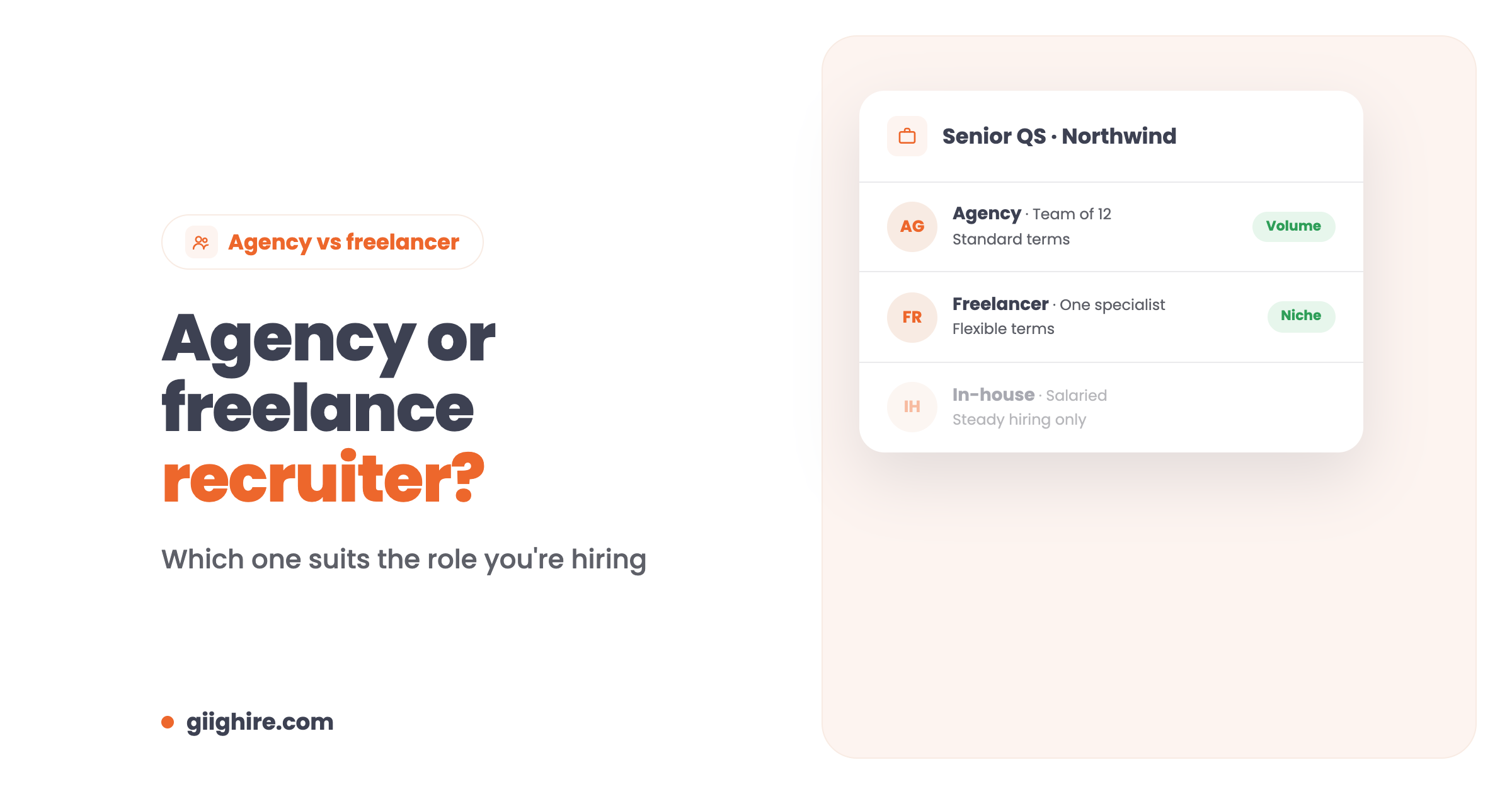
A recruitment agency gives you a team, a big database and a standard process. A freelance recruiter gives you one specialist, more flexible terms and a more personal service. Use an agency for volume and roles across lots of disciplines. Use a freelancer for specialist roles where you want one person who knows your market inside out.
Neither is better across the board. It’s a bit like a supermarket and your local butcher: one has everything and runs on systems, the other knows your name and will cut it how you like. Here’s how to choose.
What’s the difference between a recruitment agency and a freelance recruiter?
An agency is a business with several recruiters, managers and support teams. A freelance recruiter is one person running their own recruitment business.
Agencies usually work to a standard contract, while a freelancer can tailor terms to you because there’s only one person to say yes.
That’s not agencies being awkward. If you’re running hundreds of clients, bespoke terms for each would be a nightmare for finance, legal and operations, so standard terms make sense. But it does mean changes go through layers of approval. A freelancer can agree a rebate period, a payment schedule or an exclusivity window on one call.
Pricing: is a freelancer cheaper?
Sometimes, but don’t assume it. Freelancers have lower overheads, but a good specialist will still charge the going rate.
Agencies carry offices, managers, marketing, finance and legal teams, so their fees have to cover all of that. A freelancer working from a home office doesn’t, which gives them room to be flexible. But an experienced specialist who’s spent ten years in a niche is in demand, and supply and demand means they can charge the same fees they did in an agency. If a price looks too good to be true, it usually is.
Payment models
Agencies mostly work on contingency. Freelancers often offer more options, which can suit you better.
Contingency: a percentage of first-year salary, paid only when someone starts. The standard for most permanent roles.
Retained: part of the fee upfront for an exclusive, dedicated search. Best for senior or hard-to-fill roles. Here’s more on retained search.
Day rate: you pay for the recruiter’s time on agreed days. Good for part-time support or a burst of hiring.
Monthly fee: a fixed amount each month for ongoing hiring. Easier to budget, and steady income for the recruiter.
Process: KPIs vs relationships
Agencies run on process and KPIs, while freelancers can shape the process around you.
To manage big teams, agencies track activity: calls, CVs sent, interviews booked. That’s sensible, but it can lead to CVs being sent to hit a number rather than because they’re right. A freelancer isn’t chasing internal targets. Their name and reputation are on every hire, so they’ve every reason to send fewer, better candidates.
When to use a recruitment agency
Use an agency when you need scale, speed across several disciplines, or temp workers at short notice.
You’re hiring lots of people at once
The roles cover different functions
You need temps or contractors supplied and paid every week
You want one supplier for everything
When to use a freelance recruiter
Use a freelancer when the role is specialist, you want one dedicated person, or you’d like flexible terms.
Specialist or niche roles where market knowledge matters
Confidential or senior hires
You want the same person from brief to offer
You’d prefer a retainer, day rate or monthly fee to a big placement fee
What about an in-house recruiter?
An in-house recruiter makes sense when you’re hiring steadily all year. If you’re making more than a handful of hires a year, a salaried recruiter can cost less than agency fees. For one-off or specialist roles, an external recruiter is usually better value.
If you’re a recruiter weighing this up
If you’re on the other side, deciding whether to stay in an agency or go freelance, the same trade-offs apply: freedom and the full fee versus support and a salary. Read the complete guide to becoming a freelance recruiter before you jump. If you go solo, you’ll need somewhere to run it all: Giig’s free recruitment CRM is free forever for one user.
Frequently asked questions
Is a freelance recruiter cheaper than an agency?
Not always. Freelancers have lower overheads, so they can be more flexible, but experienced specialists usually charge similar fees to agencies, often 15 to 25% of first-year salary. Where freelancers can save you money is through day rates, monthly fees or tailored terms.
Are freelance recruiters as good as agency recruiters?
The best ones often are, especially in a niche. Many freelancers spent years in agencies before going solo. The difference is capacity and support: one person can’t run as many roles at once as a team, so check they have time for yours.
Can I use a freelance recruiter and an agency at the same time?
Yes, many companies do. Just be clear about who’s working which role, agree how candidate ownership works if two recruiters send the same person, and check each set of terms so you don’t end up paying twice.
What should I check before hiring a freelance recruiter?
Their niche and track record, references from past clients, how many roles they’re working on, their terms (fee, rebate period, payment terms) and that they’re registered with the ICO and insured. Ask how they’ll keep you updated.
How do freelance recruiters charge?
Most charge a contingency fee, a percentage of the candidate’s first-year salary paid on placement. Many also offer retained searches with part of the fee upfront, or a day rate or monthly fee for ongoing hiring.
Final thoughts
Agencies bring scale and process. Freelancers bring focus and flexibility. Choose based on the role: lots of hires across different areas suits an agency, a specialist role where you want one dedicated expert suits a freelancer.
This website uses cookies so that we can provide you with the best user experience possible. Cookie information is stored in your browser and performs functions such as recognising you when you return to our website and helping our team to understand which sections of the website you find most interesting and useful.
Strictly Necessary Cookies
Strictly Necessary Cookie should be enabled at all times so that we can save your preferences for cookie settings.
If you disable this cookie, we will not be able to save your preferences. This means that every time you visit this website you will need to enable or disable cookies again.