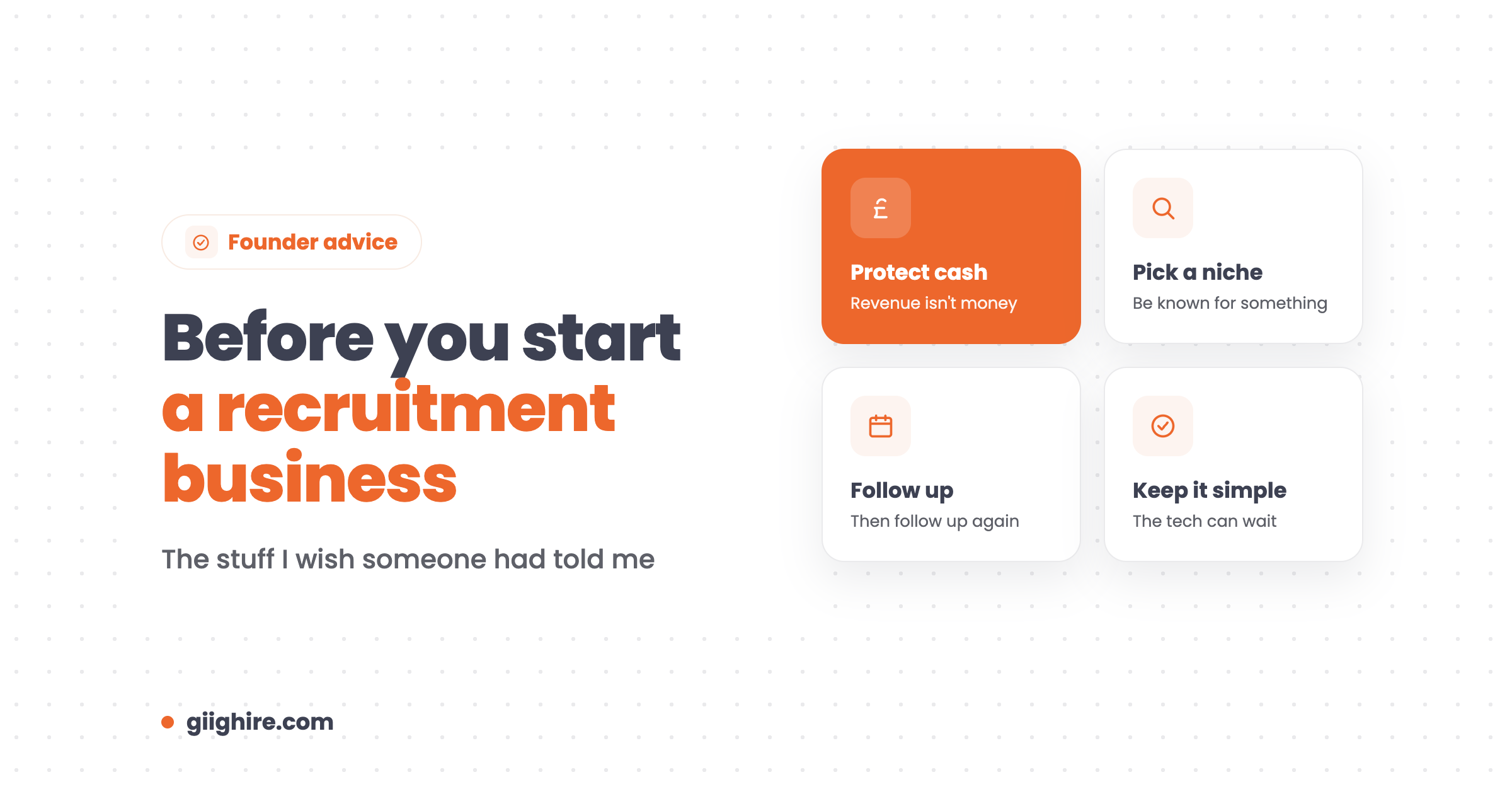
If you’re about to start a recruitment business, the honest advice is: keep it simple, protect your cash, pick a niche, and spend your time talking to clients and candidates rather than perfecting your tech. Most new agencies don’t fail because the founder can’t recruit. They fail because they run out of money or never build a proper sales pipeline.
Over the last few years I’ve spoken to hundreds (probably thousands) of recruitment founders. People just starting out. One-person agencies. Teams growing from 2 to 10 to 20. People who’ve built brilliant businesses, and a few who’ve gone back to employment.
You start to notice patterns. The same challenges, the same mistakes, the same lessons. So if someone was about to leave their job and launch their own recruitment agency, this is what I’d tell them. For the step-by-step setup (company, compliance, costs), read how to start a recruitment agency.
Should you start a recruitment business at all?
You should start one if you can consistently bill, you’re happy doing business development, and you have enough savings to survive a few slow months. If not, it’s worth waiting and building towards it.
There’s a lot of noise telling recruiters to “just go solo”. Most recruiters could. Not all of them should, and that’s fine.
You’re probably ready if…
You might want to wait if…
You bill consistently, not just once in a blue moon
You think it’ll be easier than employment
You can win your own clients
Your clients have always been handed to you
You’ve got a financial buffer for the first few months
You’d need a placement in month one to pay the rent
You like freedom and can hold yourself accountable
You need someone checking your BD hours
You care about reputation, not just the money
It’s purely about earning more
If you’re in the right-hand column, no shame. Stick it out, level up, and build towards it properly. When you’re ready, you’ll know.
1. Don’t overcomplicate it from day one
Start simple, because nothing matters more at the beginning than speaking to clients and candidates.
I see this all the time. People haven’t made their first placement yet, but they’re already worrying about the perfect CRM, website, tech stack, processes and automation. All of that matters, eventually. You can improve it as you grow.
You don’t even need to pay for your CRM at the start. Giig’s free recruitment CRM is free forever for one user.
2. Protect your cash
Revenue and cash are very different things, and cash is what keeps you in business.
You can have an amazing month on paper and still be stressed because invoices haven’t landed. Find out, for every client:
When they pay, and on what terms
Who signs invoices off
Whether they need a PO number
What their payment process actually looks like
A placement isn’t finished when the invoice is sent. It’s finished when the money’s in the bank.
3. Be careful what you commit to
Only sign up for tools you need right now, and avoid long contracts while you’re finding your feet.
The recruitment tech market is full of brilliant tools: AI, automation, data platforms, extensions, add-ons. Some are excellent. But every £100 a month subscription feels small, until you’ve got ten of them. Look for month-to-month pricing so you can cancel what doesn’t earn its keep.
4. Pick a niche
The recruiters I see gain traction quickly become known for something specific: a market, a skill set, or a problem they solve.
Not “we recruit everything”. It’s much easier to build a reputation, get referrals and charge proper fees when people know exactly what you do.
5. Don’t assume your old clients will follow you
Some old relationships will turn into business, but many won’t, so build new ones from day one.
This one comes up a lot. Businesses change, processes change, preferred supplier lists exist, restrictive covenants exist, and timing matters. Keep in touch with your old contacts, but don’t build your forecast around them.
6. Learn to do business development before you leap
If you’ve never had to win your own clients, practise before you resign, because agency ownership lives or dies on BD.
You’ll need to prospect, pitch, negotiate and close on your own steam. If that makes you break into a cold sweat, work on it now. Here’s a guide on how to sell recruitment services to get you started.
7. Your network is more valuable than you realise
Running a recruitment business can be lonely, so find other founders you can talk to openly.
Suddenly everything’s on you: sales, marketing, finance, decisions, problems. Having people around who understand what you’re going through makes a massive difference. If you’re in the UK, the TEAM Network is a great place to start.
8. Follow up more
Most opportunities aren’t won from one message, so follow up more than feels comfortable.
People are busy. They forget. The timing isn’t right. The number of opportunities sitting in someone’s inbox because nobody followed up is crazy. Be persistent without being annoying, and use a CRM with tasks and reminders so nothing gets forgotten.
9. Stop comparing yourself online
LinkedIn is a highlight reel, so focus on your own numbers, not everyone else’s announcements.
Record months, new hires, big wins. That’s great for them. You’re not seeing the difficult months, the candidates pulling out, the deals falling over and the stress behind the scenes.
10. Use technology, but don’t hide behind it
Use AI and automation to have more conversations, not to replace them.
AI is going to change recruitment. Automation is powerful, and the right software saves hours. Connecting an AI assistant like Claude to your CRM can take a lot of the admin off your plate. But recruitment is still built on relationships. Nobody ever placed a candidate by hiding behind a dashboard.
11. Enjoy building it
Don’t forget to enjoy the process, because that’s what founders remember.
Everyone’s always chasing the next placement, the next client, the next hire. But when I speak to people who’ve built successful recruitment businesses, they rarely talk about one invoice. They talk about the journey, the people, the lessons, and the moments they nearly gave up but didn’t. Building something is hard. That’s also what makes it worth it.
The mistakes I see most often
The most common mistakes are no plan, no niche, underestimating costs and payment times, a weak candidate network, ignoring compliance, and hoping clients find you.
Winging it without a plan. Know how many placements you need to break even.
Trying to recruit for everyone. Niche down.
Underestimating start-up costs and the wait to get paid.
A thin candidate database. Start building it properly from your first call.
Neglecting compliance. Terms of business, GDPR and right to work checks matter from day one.
No marketing. Clients won’t find you on their own. Post, network and follow up.
For the right person, yes. You keep the fee rather than a commission split, and you control your market and your time. But it’s harder than employment in the early months, so it’s worth it if you can win clients, handle uncertainty and have a cash buffer.
Who shouldn’t start a recruitment agency?
Recruiters who’ve never had to win their own clients, who need income from month one, or who think it’ll be an easier job. None of those are permanent. Build your BD skills and savings first, and you can start later from a much stronger position.
How much money do I need to start a recruitment business?
Enough to cover your personal and business costs for three to six months. The tools don’t need to be expensive: Giig’s CRM is free for one user. The real cost is the gap before your first placement pays, which is often a couple of months or more.
What’s the biggest mistake new recruitment agency owners make?
Running out of cash, usually because they assumed old clients would follow them or didn’t know how long invoices take to be paid. Close behind is spending months perfecting the brand and tech stack instead of talking to clients and candidates.
Do I need a recruitment CRM from day one?
Yes. Even as a solo recruiter, a CRM stops candidates, follow-ups and client conversations getting lost. Starting on spreadsheets means a painful move later. Giig is free forever for one user, with paid plans from £14.99 per user/month +VAT, no contract, cancel anytime.
Final thoughts
Starting a recruitment business is one of the best things you can do if you’re ready for it. Keep it simple, look after your cash, pick a lane, follow up, and find people to lean on.
If you want somewhere to keep your candidates and clients from day one, start on Giig for free. It costs nothing until you need more.
This website uses cookies so that we can provide you with the best user experience possible. Cookie information is stored in your browser and performs functions such as recognising you when you return to our website and helping our team to understand which sections of the website you find most interesting and useful.
Strictly Necessary Cookies
Strictly Necessary Cookie should be enabled at all times so that we can save your preferences for cookie settings.
If you disable this cookie, we will not be able to save your preferences. This means that every time you visit this website you will need to enable or disable cookies again.