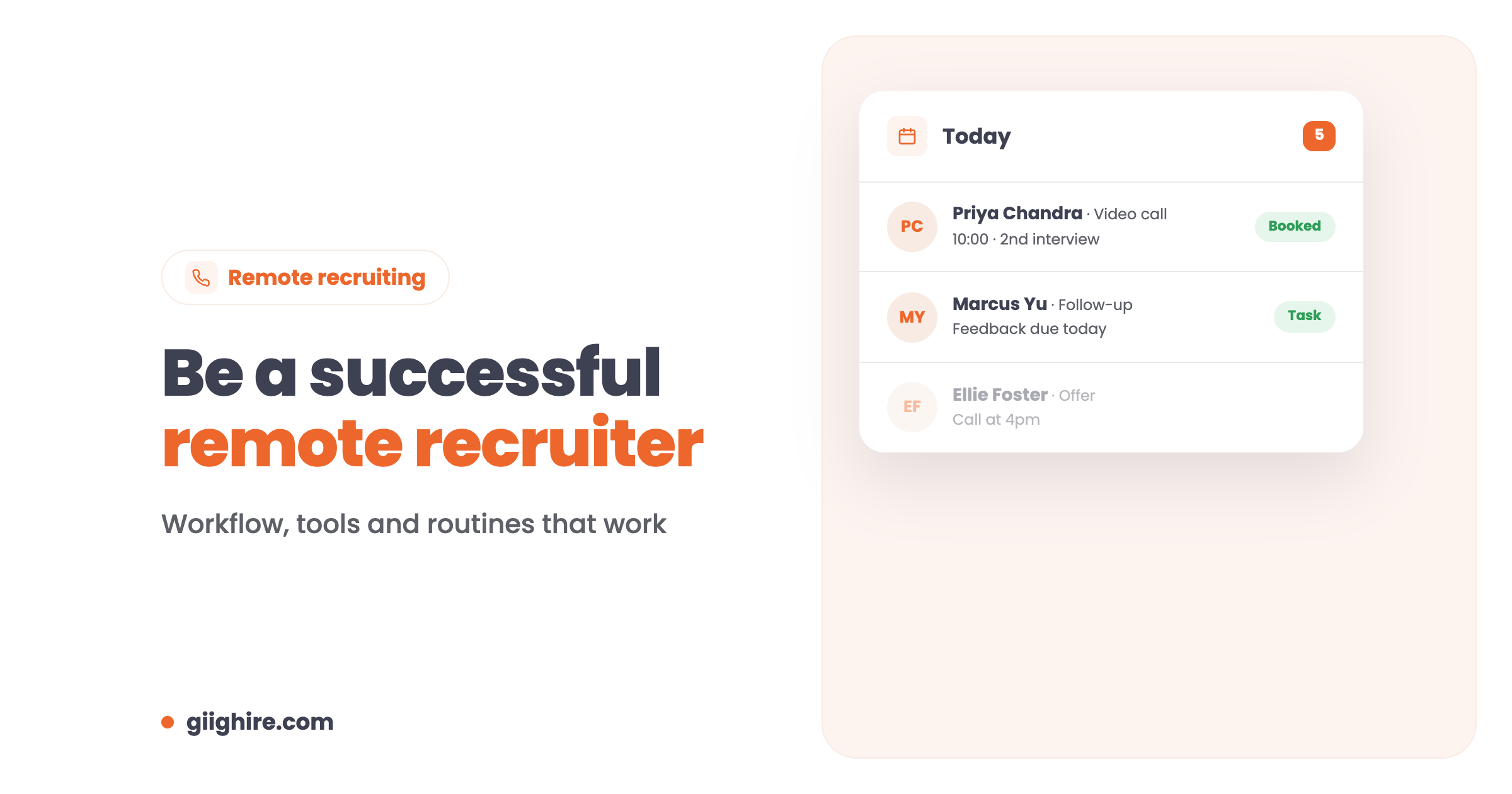
To be a successful remote recruiter, you need a simple, repeatable workflow in one CRM, communication habits that keep everyone updated without being in the room, strong online sourcing skills, a niche, and a routine that stops home life and work blurring together. Get those right and working remotely is a big advantage, not a compromise.
Remote recruiting isn’t a trend any more. It’s how lots of agencies, in-house teams and solo recruiters work. But here’s what most people won’t say out loud: working remotely is brilliant, but it isn’t easier. You need structure, discipline and the right set-up. This guide covers how to do it well, and where to find remote recruiter jobs if you’re looking.
What is a remote recruiter?
A remote recruiter is a recruiter who works from home, a co-working space or anywhere else instead of an office. The job’s the same: sourcing, screening, managing clients, running interviews and closing offers. You just do it all online.
It suits independent recruiters and small agencies particularly well, because there’s no office to pay for and you’re not limited to candidates or clients in one town.
Why remote recruiting works
Remote recruiting gives you a bigger talent pool, lower costs and more control over your day.
More candidates: you’re not limited by geography.
More clients: you can support companies anywhere.
Lower costs: ideal for solo recruiters and start-ups.
Better balance: no commute, fewer interruptions.
Easier to scale: good tools do a lot of the heavy lifting.
The downsides are real too: it can get lonely, it’s easy to get distracted, and you have to work harder at communication.
1. Set up a workflow that works
When you work remotely, your workflow is your office. If it’s messy, everything gets stressful.
One CRM for everything. Candidates, clients, jobs, notes, pipelines and follow-ups in one place. If you don’t have one, Giig’s free recruitment CRM has no data limits for one user.
Scheduling links so you’re not going back and forth over interview times.
The same process for every role, so you’re fast and consistent. Here’s how to build a recruitment workflow.
Templates for outreach, updates, briefs and rejections.
Remote recruiters live and die by communication, because you’re never in the room with your client or candidate.
The best remote recruiters are clear, quick to update, easy to reach and brilliant at setting expectations. And the biggest tip: don’t disappear between interviews. Keep both sides in the loop, even when there’s no news. A good candidate experience matters even more when people have never met you.
3. Get great at online sourcing
Remote recruiting means you need to be brilliant at finding people online, not just posting adverts.
Your own database first
LinkedIn, and Boolean search
Specialist sites, like GitHub for developers or Behance for creatives
Niche forums and online communities
Talent pools built in your CRM
Passive candidates are where the gold is. If you can start conversations and keep in touch over time, you’ll fill roles faster than any CV shuffler. More in this guide to candidate sourcing.
4. Pick a niche
Generalists struggle more remotely, because you’re competing with recruiters everywhere. Pick a niche, own it and become known for it. Candidates trust you more when you “get” their world, and clients find you more easily.
5. Build trust from a distance
Remote recruiting works when people trust you, and trust comes from keeping your word, not ghosting anyone, giving honest feedback and listening more than you sell. In a remote world, your reputation does a lot of the selling. Here’s more on building trust as a recruiter.
6. Use tools that make life easier
Your tools are your remote office, so keep them simple and make them work together.
Need
Tools to look at
CRM and ATS
Giig
Video calls
Zoom, Google Meet, Microsoft Teams
Scheduling
Calendly or your calendar’s booking pages
Screening and assessments
Toggl Hire, Vervoe
Automation
Zapier
Notes and team chat
Notion, Slack
On Giig AI, you can also connect Claude to your CRM and ask it to find candidates or prep for client calls in plain English.
7. Look after yourself
Working remotely needs a routine, or work and home blur into one long day.
Have a dedicated workspace, ideally one you can walk away from at the end of the day.
Keep set hours, especially if you work with clients in other time zones.
Take proper breaks. Get outside at lunchtime.
Find your people. Other recruiters, a local network or a co-working space make a big difference when you work alone.
How to find remote recruiter jobs
Remote recruiter jobs come from three places: remote roles at agencies and companies, freelance recruiting platforms, and winning your own clients.
Job boards: search “remote recruiter” or “remote recruitment consultant” on the big boards and LinkedIn, and filter by remote. Here are the best free job posting sites, which are the same places to look.
In-house and RPO roles: many in-house talent teams and RPO providers hire remote recruiters on contract.
Whichever route you take, build an online presence first: a clear LinkedIn profile about your niche, regular posts, and a simple website. People will look you up before they hire you.
Frequently asked questions
What does a remote recruiter do?
A remote recruiter does everything an office-based recruiter does (sourcing, screening, managing clients, running interviews and closing offers) but works from home or anywhere else, using a CRM, video calls, email and phone instead of meeting rooms.
How do I become a remote recruiter?
Get recruitment experience first, ideally in a niche. Then look for remote roles at agencies, in-house teams or RPO providers, take on work through freelance recruiting platforms, or go freelance and win your own clients. A strong LinkedIn presence helps with all of them.
What tools does a remote recruiter need?
A recruitment CRM and ATS, a video calling tool, a scheduling tool, email templates, and somewhere to keep notes. Keep it simple and make sure everything feeds into one CRM, so candidates and follow-ups don’t get lost.
Is remote recruiting harder than office-based recruiting?
It’s different. You get flexibility and a bigger talent pool, but you lose the energy and quick learning of an office. Remote recruiters need more discipline, better communication and a routine. With the right set-up, many do better than they did in an office.
Can remote recruiters earn as much as office-based recruiters?
Yes. Earnings depend on your niche, fees and placements, not where you sit. Freelance remote recruiters keep the whole fee, so they can earn more, but they also carry their own costs. Here’s how much freelance recruiters make.
Final thoughts
Being a successful remote recruiter isn’t about working in your pyjamas (although sometimes, yes). It’s about structure, clear communication, a niche, good tools and looking after yourself. Get those right and you can build a recruitment career, or an agency, that fits around your life rather than the other way round.
Want everything in one place, wherever you work? Start on Giig for free. No credit card, no contract.
This website uses cookies so that we can provide you with the best user experience possible. Cookie information is stored in your browser and performs functions such as recognising you when you return to our website and helping our team to understand which sections of the website you find most interesting and useful.
Strictly Necessary Cookies
Strictly Necessary Cookie should be enabled at all times so that we can save your preferences for cookie settings.
If you disable this cookie, we will not be able to save your preferences. This means that every time you visit this website you will need to enable or disable cookies again.