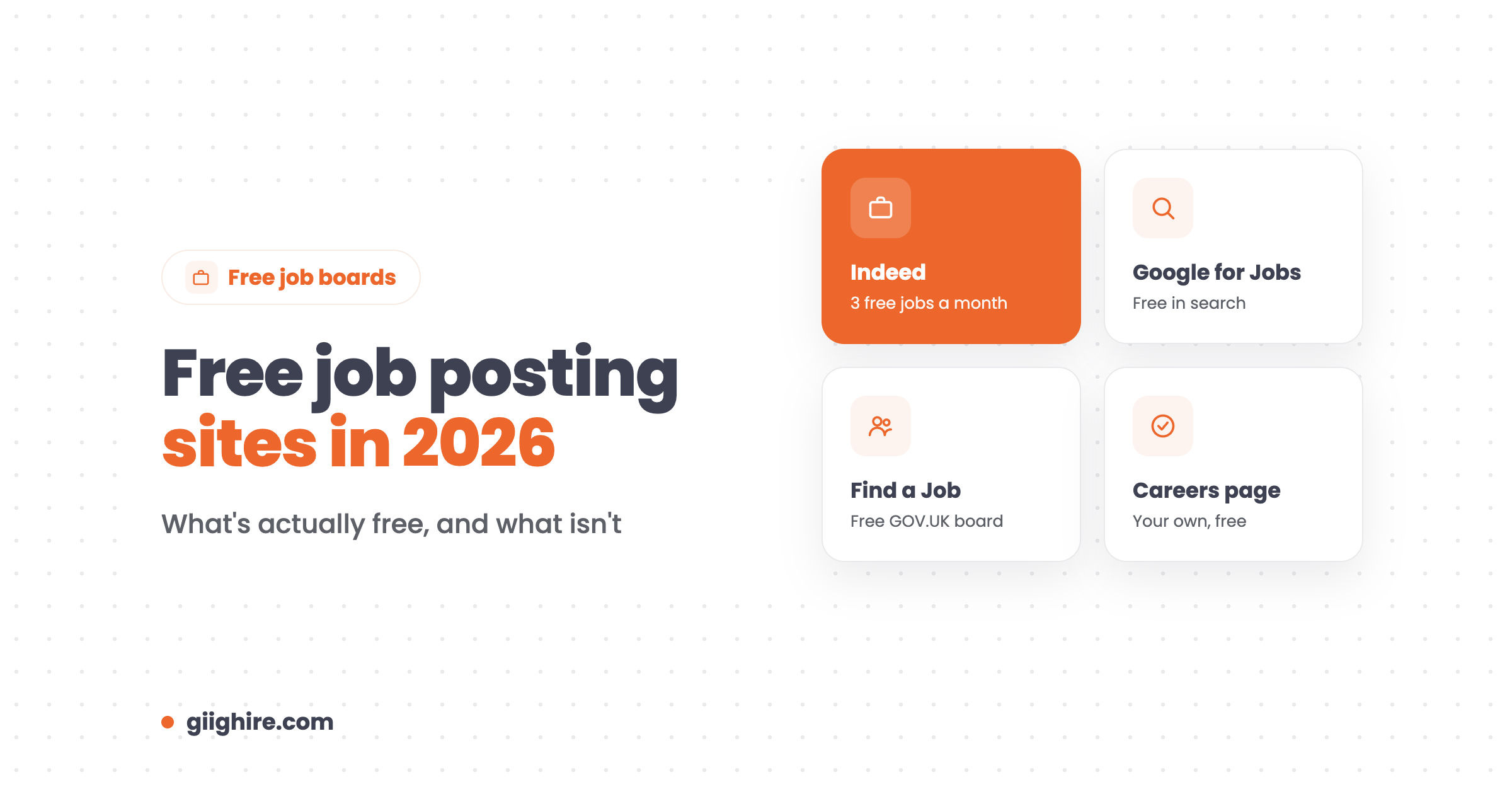
The best free job posting sites in the UK in 2026 are Indeed (three free jobs a month), Google for Jobs, LinkedIn (one free job at a time, but not for agencies), the government’s Find a Job service, and your own careers page. Most other “free” job boards are now either a free trial, a limited taster or no longer take direct posts, so it’s worth knowing what you’ll actually get before you post.
Job advertising gets expensive quickly, so free options are worth using properly. I’ve updated this list for 2026, because quite a lot has changed: some boards have merged, some have stopped taking posts and the free limits have tightened. Here’s what’s genuinely free right now, and what to watch out for.
The 10 best free job posting sites at a glance
Site
What’s free
Watch out for
Indeed
Up to 3 free jobs a month, live for up to 30 days
Free posts lose visibility over time
Google for Jobs
Free listing in Google search
Your job must be on a page Google can read as a job post
LinkedIn
One free job at a time
Recruitment agencies can’t post free jobs
Find a Job (GOV.UK)
Free
Agencies can post only when running the full recruitment for the employer
Your own careers page
Free with Giig, up to 3 live jobs
You need to drive people to it
Monster
One free post a month
Very limited applicants on the free post
ZipRecruiter
A short free trial
It’s a trial, not a free plan
Social media
Free posts on LinkedIn, Facebook and X
Reach depends on your network
Niche communities
Often free or cheap
Smaller audiences, but the right people
University careers services
Often free for graduate roles
Only suits graduate and entry-level roles
Free limits change often, so check each site’s own terms before you rely on them. These were checked in October 2026.
1. Indeed
Indeed is still the biggest free option: you can post up to three free jobs each calendar month, and each stays live for up to 30 days.
Free posts appear in normal search results, but Indeed says they lose visibility over time. If you need more reach, you can sponsor a job with your own budget and stop or pause it whenever you like.
Best for: most roles, especially volume and entry-level hiring.
Watch out for: a flood of unsuitable applicants. Use screening questions.
2. Google for Jobs
Google for Jobs shows job listings directly in Google search, and it’s free. You can’t pay to rank higher.
The catch is that you don’t post to Google directly. Your job needs to sit on a web page with the right job posting markup, or on a site that already feeds jobs to Google. Many job boards and some careers pages do this for you.
Best for: getting local, search-led visibility for free.
Watch out for: jobs that don’t show up because the page isn’t set up properly.
3. LinkedIn
LinkedIn lets you post one free job at a time, but staffing and recruitment agencies can’t post free jobs, so this one is mainly for employers hiring directly.
Free posts also have limits on how long they’re shown and how many people see them, and LinkedIn may not offer the free option for high-demand roles. Promoting a job means paying from a daily or total budget. Even if you can’t post free, sharing a role from your own profile is free and often works well. Here’s how much LinkedIn Recruiter costs if you’re weighing up paid options.
Best for: employers hiring for professional roles.
Watch out for: the agency restriction and limited free reach.
4. Find a Job (GOV.UK)
Find a Job is the UK government’s free job board, run by the Department for Work and Pensions.
Recruitment agencies can post when they’re carrying out the full recruitment for the employer. Adverts need to describe a real job, be honest about pay, and come down when the role is filled.
Best for: entry-level, local and hourly-paid roles.
Watch out for: a less specialist audience than niche boards.
5. Your own careers page
Your own careers page is free, it’s yours, and every applicant comes straight to you rather than through a job board’s inbox.
Giig’s free careers page is included on the Free Forever plan with up to three live jobs at a time, which you can rotate as often as you like. Starter raises that to 10 and Plus removes the limit. Every application lands straight in your ATS, so no CVs get lost. You can link to it from your website, your email signature and every LinkedIn post.
Best for: building your own pipeline instead of renting someone else’s.
Watch out for: you need to send traffic to it yourself.
Monster offers one free job post a month, but the free post is very limited, with only a handful of applicants allowed.
Monster and CareerBuilder merged, and the combined business went through a US bankruptcy process in 2025, so check what’s on offer in the UK before you build it into your plans.
Best for: a free extra posting alongside Indeed.
Watch out for: low applicant numbers on the free option.
7. ZipRecruiter
ZipRecruiter offers a short free trial rather than a free plan. Your card is charged automatically if you don’t cancel before the trial ends, so set a reminder.
Best for: testing whether it works for your roles.
Watch out for: forgetting to cancel.
8. Social media
Posting jobs on LinkedIn, Facebook and X from your own profiles is free, and for niche roles it can beat a job board.
Write the post like a person, not an advert: what the role is, the salary, why it’s good, and a link to apply on your careers page. Ask your network to share it.
Best for: roles where your network already knows the right people.
Watch out for: reach depends on how active you are.
9. Niche communities
Industry Slack groups, forums, professional bodies and local business groups often let you post jobs for free or very cheaply, and the audience is exactly who you want.
Best for: specialist and senior roles.
Watch out for: each community has its own rules on posting jobs, so read them first.
10. University careers services
Most universities run careers services and job boards for students and graduates, and posting is often free for employers.
Best for: graduate schemes, internships and entry-level roles.
Watch out for: they’re no good for experienced hires.
What happened to the others?
Some boards that used to be on free job site lists have changed:
Glassdoor no longer takes job posts directly. Jobs reach Glassdoor through Indeed.
SimplyHired is part of the Indeed group, and jobs posted there also appear on Indeed.
Jora stopped taking new direct job posts in 2026 and now lists jobs collected from other sites.
CareerBuilder now runs on Monster’s plans after the two merged.
Jobvite is applicant tracking software, not a job board.
What about paid job boards?
The big UK paid boards, like CV-Library, Totaljobs and Reed, don’t offer free posting, but they often run deals for new customers and include CV database access. For specialist roles, one paid niche board can be worth more than five free general ones.
If you post to several boards, a multiposter saves a lot of logging in and out. On Giig Plus, the idibu integration lets you write your advert once and push it to the boards you use, with every applicant landing in your CRM. You’ll need your own idibu account and job board contracts.
Indeed (up to three free jobs a month), Google for Jobs, LinkedIn (one free job at a time for direct employers), the government’s Find a Job service, your own careers page, social media, niche communities and university careers services. Free limits change, so check each site’s terms before posting.
Can recruitment agencies post free jobs on LinkedIn?
No. LinkedIn doesn’t let staffing and recruitment agencies post free jobs, so agencies need to promote jobs on a paid basis. Agencies can still share roles for free from their own profiles and company page, which often works well for niche roles.
Is Indeed still free to post jobs?
Yes, with limits. Employers posting directly on Indeed can publish up to three free jobs per calendar month, each live for up to 30 days. Free posts lose visibility over time, and you can sponsor jobs if you need more reach.
How do I get my jobs on Google for Jobs?
You can’t post to Google for Jobs directly. Your job needs to be on a web page with the right job posting markup, or listed on a job board or careers site that sends its jobs to Google. It’s free, and you can’t pay to rank higher.
Is it worth paying for job boards?
Often, for specialist roles. Paid boards like CV-Library, Totaljobs and Reed reach more candidates and include CV database access. Start with free options and your own database, then pay for the one or two boards that actually produce placements in your niche.
What’s the best free job board for recruiters?
For agencies, Indeed is usually the best free job board, alongside your own careers page and Find a Job. LinkedIn’s free posting isn’t available to agencies. Your own database is the best free source of all, so search it before you advertise.
Final thoughts
Free job posting still works in 2026, but the limits are tighter than they used to be. Use Indeed’s free posts, get your jobs onto Google, use Find a Job for local roles, and build your own careers page so every applicant comes straight to you. Then put your budget into the one paid board that works for your niche.
This website uses cookies so that we can provide you with the best user experience possible. Cookie information is stored in your browser and performs functions such as recognising you when you return to our website and helping our team to understand which sections of the website you find most interesting and useful.
Strictly Necessary Cookies
Strictly Necessary Cookie should be enabled at all times so that we can save your preferences for cookie settings.
If you disable this cookie, we will not be able to save your preferences. This means that every time you visit this website you will need to enable or disable cookies again.